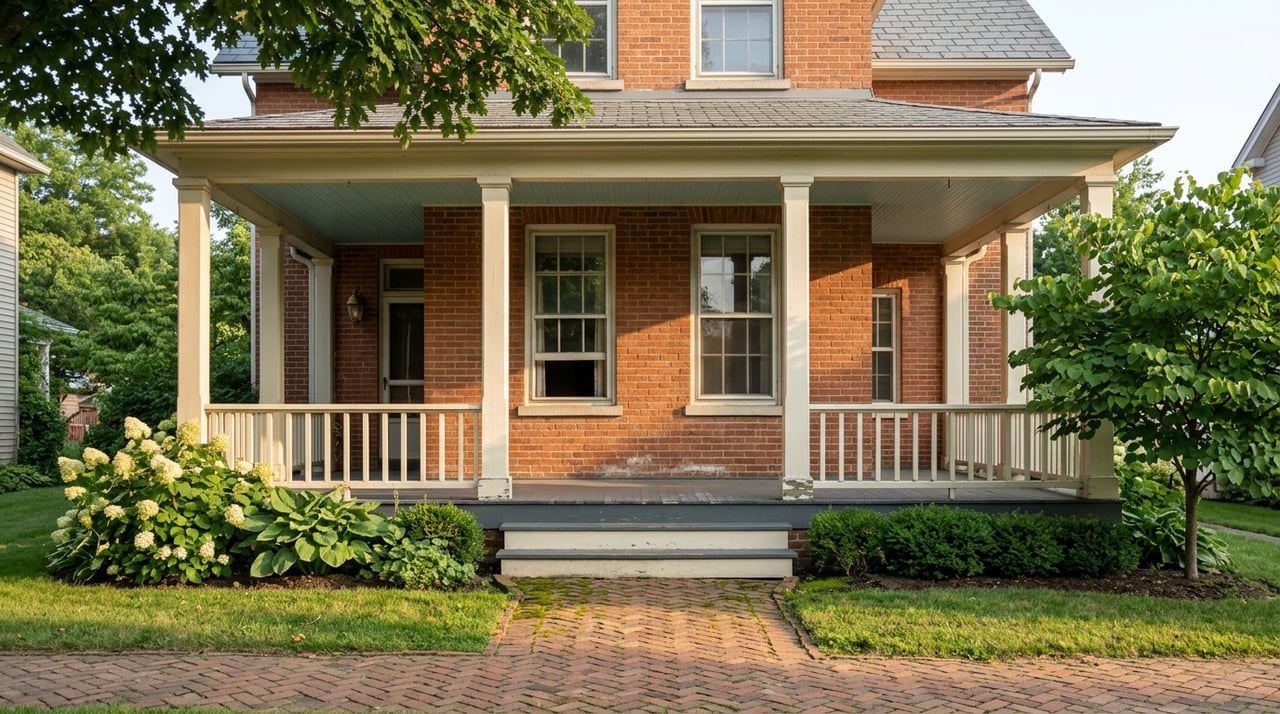
Drive Route 90 along Cayuga Lake's east shore into the village of Aurora and the campus arrives before the water does. White clapboard dormitories, a modernist library designed by Walter Netsch, a quiet quad that used to hold a few hundred students most of the year. None of them are there anymore. Wells College closed after 156 years in 2024, and the 127-acre campus has sat largely empty since, its ownership still being argued over in Cayuga County Court as of this summer.
For a buyer comparing a lakefront listing in Aurora against something similar a few miles up the shore in King Ferry or Union Springs, that empty campus can register as local color, the kind of detail an agent points out on a tour and drives past. It deserves more attention than that. Wells' closure affected village services and finances, including water, sewer, the volunteer fire department, and the tax base the village budget is built on. None of that shows up in a median price. Those details are worth considering alongside a property's price.
A College That Also Ran the Water Plant
Wells College was founded in 1868 as a women's college and had been Aurora's largest employer for most of its existence. Enrollment had been sliding for years, from 530 students in 2011 to 335 in 2022, and the college lost $11 million over a two-year period according to its own tax filings. The trustees announced the closure on April 29, 2024, one day before the deadline most American colleges use for incoming students to commit, which meant an already-admitted freshman class had to scramble along with faculty who had missed the academic hiring season entirely.
What made the closure different from a typical small-college shutdown was the plumbing. Wells had built and operated Aurora's water treatment plant for more than a century, originally to serve its own students. As the village grew, local government simply bought water from the college rather than build its own system. When Wells closed, that arrangement closed with it, and the village had no choice but to take over a facility it had never had to budget for.
How the College Closure Affected Village Services
Before the closure, Aurora counted Wells students in its official population, putting the village at around 600. Once the college closed, that number fell to under 300. That is not a statement about who lives in the houses along the shore. It is a statement about how few taxpayers are now splitting costs that used to be shared with an institution.
The fire department lost a quarter of its volunteers overnight. The sole local doctor had to reassure patients they would still get care for chronic conditions. And Mayor Jim Orman had to figure out, with no precedent to work from, how to keep the water plant running.
"New York State told me that there's no template for this. They don't know of any other situation like this in the state."
That is Orman, describing the water plant takeover to CNY Central. The unexpected cost of running the plant, mostly the certified operators the village had to hire, pushed Aurora's budget up roughly 27 percent, from a planned $1.1 million to about $1.4 million. Orman told CNY Central that residents should expect water rates to double or triple, though the exact figure was still being worked out. The sewer fund took a smaller but similar hit: Wells had paid the village $50,000 in the 2023-24 budget year for processing the college's waste, a figure that dropped to $46,000 the following year, nearly 21 percent of the village's entire $222,610 sewer fund appropriation.
None of this is unique to Aurora as a category of small town losing an anchor institution. What is unique is that a lakefront buyer evaluating this specific village on this specific shore of Cayuga Lake is, whether they realize it or not, also evaluating a municipality mid-way through absorbing a utility system it never planned to own.
The Campus Sale That Keeps Falling Apart
The other half of the story is what happens to the 127 acres themselves, and it has been anything but settled. The timeline, compressed:
- April 2024 — Wells announces closure, effective that summer.
- Through 2025 — A months-long sale process draws multiple bidders, including an early $10.8 million offer from the Hiawatha Institute for Indigenous Knowledge.
- January 2026 — Wells' trustees accept a revised $12.5 million offer from Hiawatha, whose proposal called for converting three former dormitories into 80 to 100 market-rate apartments priced below the regional median, eventually followed by an accredited Indigenous college on the rest of the site, according to Hiawatha's own redevelopment plan.
- April 2026 — A Cayuga County Court judge approves the sale over objections from the Cayuga Nation and a Wells alumna who had submitted a competing bid.
- May 2026 — The Minerva Institute, another unsuccessful bidder, files its own petition arguing the trustees never ran a fair bidding process.
- June 2026 — Wells' attorneys tell the court the sale is off. Hiawatha failed to close on the property and did not cure its default, according to court filings. Hiawatha disputes the decision and says it still intends to buy the campus once Wells can provide clear title.
As of the most recent reporting, the campus is back on the market with no buyer under contract. Whatever comes next across the road from Aurora's lakefront homes, apartments, an institute, something else entirely, is still an open question rather than a settled fact a buyer can price against.
Why This Is a Village Story, Not a Lake Story
It matters to be precise about the geography here. This is a story about the incorporated Village of Aurora, in the Town of Ledyard, on one stretch of Cayuga Lake's east shore. It is not a statement about the rest of the lake, which stretches nearly 40 miles from Ithaca north to Seneca Falls. King Ferry, Union Springs, and Genoa sit further up Route 90 with their own separate tax bases and utility systems, untouched by what happened at Wells.
Aurora still has a private-sector anchor holding the village together commercially. The Inns of Aurora, the hospitality company that runs several properties in the village, told The Citizen it has no plans to buy any of the Wells-owned real estate but hopes whatever emerges is "symbiotic" with what it already operates there. And the village's older core, the Aurora Village Historic District, has been listed on the National Register of Historic Places since 1980, which is part of why the Preservation League of New York State named the Wells campus to its 2025-2026 Seven to Save list, a designation meant to draw attention and advocacy to at-risk historic properties rather than resolve their ownership.
What to Actually Ask Before You Write an Offer
None of this means Aurora is a bad place to buy on Cayuga Lake. It means the due diligence looks a little different than it would on a stretch of shoreline where the local tax base and utility infrastructure haven't just been through an unplanned transition. Before writing an offer on lakefront property near the village, it is worth asking:
- What has the village budget looked like for the past two fiscal years, and are further water or sewer rate increases already being discussed?
- Is the property on village water and sewer, or an independent well and septic system that sidesteps the plant question entirely?
- Where does the campus sale currently stand, since whatever eventually gets built or preserved there will shape traffic, noise, and demand on that stretch of shore for years?
These are the kinds of questions that separate a comparable-sales printout from an actual read on a market. On Cayuga Lake, where villages a few miles apart can be living through entirely different fiscal realities, that distinction is worth more than another point of view of the water.
FAQ
Does the Wells College closure raise property taxes for lakefront homes near Aurora? Village tax rates fund village services, so a larger village budget driven by water plant operations can affect the village portion of a tax bill for property located within Aurora itself. Homes on the east shore outside the village limits are taxed under separate town and county rates not tied to this situation.
Is the Wells College campus going to become apartments or a new college? Not yet, and not on any confirmed timeline. The most detailed redevelopment plan on record, the Hiawatha Institute's proposal for market-rate apartments and an eventual Indigenous college, was tied to a sale that fell apart in June 2026. The campus is back on the market with no signed buyer.
Should this change how I compare an Aurora listing to one on a different part of Cayuga Lake? It should change what questions you ask rather than whether you consider Aurora at all. A lakefront home's value still comes primarily from frontage, depth, dock potential, and views. The village's fiscal situation is a separate layer worth understanding before you commit, not a reason to rule the area out.
Questions about a specific address on Cayuga Lake's east shore, or how a village's finances might factor into an offer, are exactly the kind of local detail worth talking through before you get attached to a listing. Nick Davoli has spent more than two decades working these shorelines and is happy to walk through what a particular property, and its village, actually looks like up close. Let's Connect.
This article is general information, not legal, tax or financial advice. Consult a qualified professional about your situation.