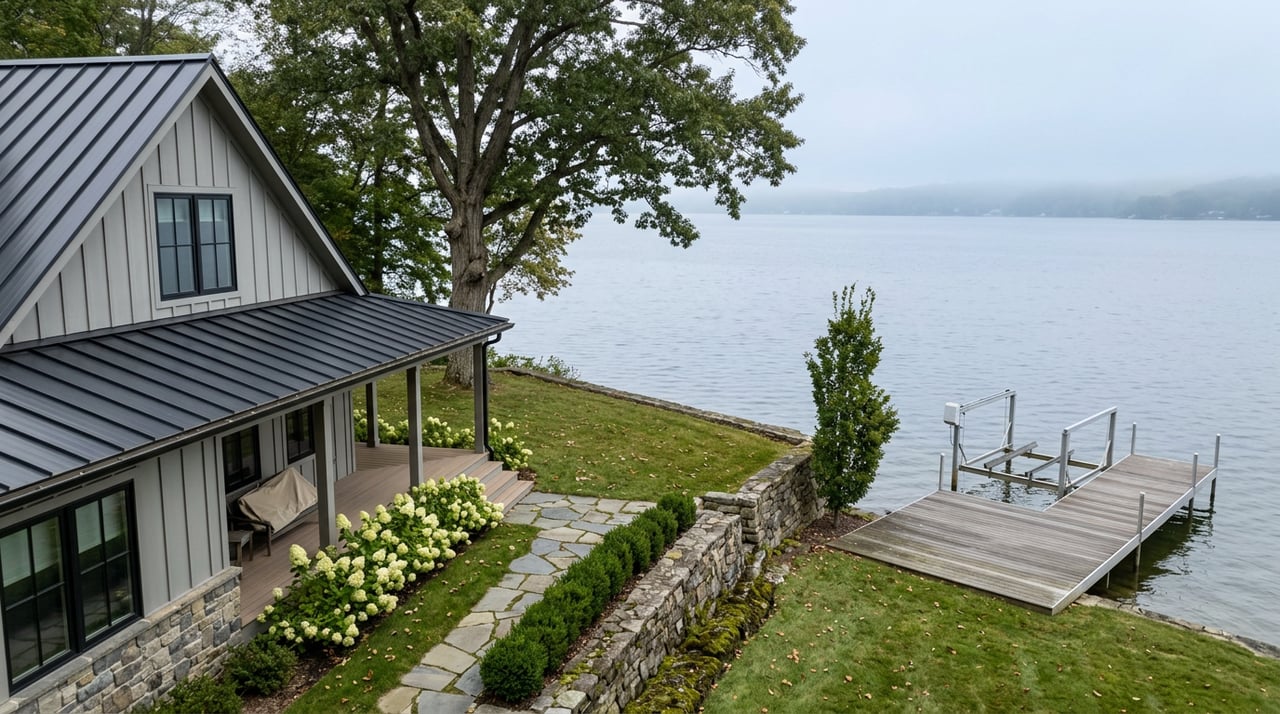
Karin Critchlow's family has owned land on Seneca Lake's west shore, in the small village of Dresden, for more than 70 years. Over that time they built two lake houses, expanded the beach area, and grew the dock. A few years ago they added something nobody in the family expected to need on a Finger Lakes property: central air conditioning. Not because Dresden got hotter. Because the nights got louder. Critchlow has described waking at two in the morning to a steady mechanical hum from roughly 500 yards away, the kind of sound she compares to a truck idling down the back road.
The source is the Greenidge Generating Station, the power plant on Route 14 in Dresden that spent the last several years mining bitcoin and just spent this summer becoming something else entirely.
If you're comparing waterfront on Seneca Lake right now, you've probably already looked at the median price and moved past it. That number tells you almost nothing about a specific parcel. What it doesn't tell you is that one stretch of the west shore, roughly between Dresden and the Town of Torrey, sits next to a 262-acre industrial site that just changed its business model, its name, and its ticker symbol, and is still working through a set of regulatory questions that haven't fully closed. That's not a reason to avoid the area. It's a reason to ask sharper questions than "what's the frontage."
A Plant That Changed What It Makes, Not Where It Sits
The facility started as a coal-fired power plant back in 1937. Atlas Holdings acquired it in 2014 and converted it to burn natural gas, operating it as Greenidge Generation. In 2019 and 2020, the company began routing some of that generated power into bitcoin mining, effectively becoming a test case for how idle power plants across New York could be resurrected as crypto operations.
That business model ran into New York's climate law almost immediately. In June 2022, the state Department of Environmental Conservation denied the plant's Title V air permit renewal, ruling that continued operation was inconsistent with the greenhouse gas limits set under the Climate Leadership and Community Protection Act. Greenidge appealed. The plant kept operating through the appeals process, as state law allows facilities to do while a renewal application works through review. That fight ran for more than three years.
It ended, sort of, in November 2025, when the DEC finalized a new five-year agreement with Greenidge requiring a 44 percent cut in greenhouse gas emissions in exchange for a renewed permit. Environmental groups in the region called the deal a retreat from the climate law's original intent. The company framed it as a path to keep providing power to the local grid. Both things can be true, and neither one is the part a buyer needs most.
The part a buyer needs is what happened next. In August 2026, Greenidge Generation Holdings ceased to exist as a company. In its place: Vulcan Infrastructure and Power, backed by roughly $39.4 million in new investment from Machine Investment Group, Atlas Holdings, Conversant Capital, and company insiders. The plant will keep generating electricity, but its stated direction is now high-performance computing, an AI data center, not bitcoin. The Nasdaq ticker switched from GREE to VIP at the end of July.
The Footprint Buyers Don't See From the Road
Here's what makes this relevant to a real estate decision rather than just local news. The site isn't a small building tucked behind a hedge. It covers 262 acres and includes a water intake pipe drawing directly from Seneca Lake, plus a stretch of the Keuka Lake outlet. Directly across Route 14 from the main plant sits the Lockwood Coal Ash Landfill, the disposal site for waste generated during the plant's coal-burning decades. A 2021 plan to convert that landfill into a solar farm stalled after an EPA investigation into groundwater monitoring. The company settled with the EPA in 2024, agreeing to a groundwater assessment and an updated closure plan. SEC filings in 2026 report a $17.3 million liability tied to that same coal landfill.
None of this means the plant is a health hazard to nearby homeowners, and this isn't a claim about property safety. It means the site carries an active regulatory file, an evolving business model, and a legacy waste liability that a buyer evaluating a specific Dresden or Torrey parcel should know exists, the same way you'd want to know about any large industrial neighbor before you commit to a shoreline lot 500 yards away.
The company also has open applications to draw more power from the state grid. As of the 2026 rebrand reporting, Vulcan's Dresden operation was already pulling 160 megawatts and had applied for an additional 260 megawatts to support the shift toward data center operations. That kind of expansion typically comes with its own permitting and public comment process, which means the story here isn't finished. A buyer who only checks the news as of closing day might be looking at old information within a year.
Why This Sits Differently Than the Rest of the Lake
Seneca Lake runs roughly 35 miles north to south with more than 75 miles of shoreline, and the towns around it don't behave like one market. Geneva anchors the north end as a college town built around Hobart and William Smith Colleges, with a walkable downtown and a strong food and arts scene. Watkins Glen sits at the south end, known for its state park and its NASCAR history, and draws heavy seasonal tourism traffic. Lodi, on the west side south of Dresden, is built around boutique wineries and vineyard-view estates. Hector, on the southeast shore, mixes lakefront homes with working vineyard land.
Dresden and Torrey don't carry any of those identities. They're quieter, more residential, closer to the Keuka Outlet Trail than to a tourist strip, and that quiet is exactly why the plant's presence registers so directly for the people who live nearest it. A buyer comparing a Dresden parcel to a similarly priced lot near Geneva or Hector isn't comparing two versions of the same product. One of them has a specific, named industrial neighbor mid-transition. The other doesn't.
What to Actually Ask Before You Write an Offer
If you're looking at waterfront on Seneca's west shore near Dresden or Torrey, a few questions belong on your due-diligence list that wouldn't come up elsewhere on the lake:
- How close is the parcel to the Vulcan (formerly Greenidge) facility, and is that distance disclosed anywhere in the listing or seller disclosure?
- Has the seller or a neighbor mentioned nighttime noise, and does it vary by season or by the facility's operating load?
- Is the property's water source connected to the lake in a way that could be affected by discharge or intake activity nearby?
- Has the seller's title work or survey noted any easements or notices tied to the adjacent landfill site?
- Are there open public comment periods or pending permit decisions that a title search wouldn't necessarily surface?
None of this is a reason to write a lower offer automatically or to avoid the corridor. Plenty of buyers value quiet, undertouristed shoreline and will find Dresden's pace appealing regardless. The point is that pricing this stretch off the same assumptions you'd use for Geneva or Hector misses something real.
A Short FAQ
Is the Dresden facility a health or safety risk to nearby homes? That's not a claim this article makes or is positioned to evaluate. What's documented is an active regulatory history, a legacy landfill liability, and resident-reported noise, all of which are reasonable due-diligence topics for a specific parcel near the site.
Does this affect the whole west shore of Seneca Lake? No. The relevant footprint is centered on Dresden and the Town of Torrey. Properties elsewhere on the west shore, including Lodi and points further south, aren't within the same proximity.
Is the facility's transition to an AI data center finalized? As of the August 2026 rebrand, Vulcan Infrastructure and Power had stated that direction and secured investment behind it, but the company's application for additional grid power was still pending, which typically involves further review.
Seneca Lake rewards buyers who ask specific questions about specific parcels instead of treating the whole shoreline as one market. If you're weighing a property near Dresden, or comparing it against Geneva, Watkins Glen, Lodi, or Hector, Nick Davoli can walk you through what's actually documented for that stretch of shoreline and what it means for your offer. Explore more about Seneca Lake waterfront property or reach out directly to talk through a specific address.


